Showing posts with label Herat. Show all posts

Friday, August 24, 2012

Qalat


QALAT

The AMF (Afghan Militia Force) was losing all of its big weapons and direct fire weapons to the DDR program. DDR was the “Disestablishment, Disarmament and Reintegration” program the Afghan government established to disarm the militias and reintegrate them into society after decades of fighting. One of the locations where there were lots of ordnance stored was a town called Qalat. Qalat is located in the Zabul Province, between Qandahar and Gazni provinces.  The province has long been a hot bed of Taliban/Al-Qaeda resistance, so it was not a friendly town…it was bandit country for sure.

Our job was to go up there destroy everything they had short of 7.62mm (AK-47) rounds. On a previous visit one of my mates had found 6 AGS-17 grenade launchers, similar to our MK-19 40mm grenade launcher, except in the 30mm version. These were very hard to come by and we found out that some of our “friends” could use them. So we decided to go there and retrieve them before blowing them up. The trick was to get them out without the garrison commander messing with us…which meant we had to have a show of force. For us that meant we had to go to the firebase and somehow ‘con’ our way into getting a patrol to provide security. First we went to an American company providing security for various NGO’s (non-government organization-us excluded, of course) and asked to have two security vehicles escort us to Qalat and back. Since the regional manager was a good drinking friend of ours he immediately agreed with us…it is good to have the only bar in town!

As always my teammate and I were loaded for bear, I think we took everything in our arsenal. We then drove up to Qalat, escorted by our “security force” consisting of two vehicles with 4 guards each. These guards we were sure had been Taliban at one time, so of course we didn’t trust them as far as we could throw them. We entered the firebase and immediately started sweet talking the commander into giving us some assistance. He must have thought we were “somebody” since he kept calling us ‘sirs’. All he saw was two Americans looking ragged by any standards, carrying lots of weapons and asking very nicely for his assistance. No only did he agree to it…but he gave us 4 HUMVEES loaded with soldiers, and two gun trucks (HUMVEES with .50 cal mounted on top). Now we were in business!!!

The cache of ordnance was located on top of a hill where the AMF had sort of a ‘fortress’. We rolled in there with an impressive show of force and meaning business. We immediately drove to the bunker we knew had the items we wanted, and told this very frightened officer that he had ten minutes to produce the keys or we were cutting the lock. As he scampered off to search for the keys everyone took positions, making sure that instead of keys he didn’t bring armed soldiers. Without much waiting, the individual returned with the keys and proceeded to open several doors. Mike and I just rushed in with flashlights on and started taking everything we wanted, including extra AK-47s.  The entire job lasted approximately 10 minutes, and as soon as we finished we closed the doors and locked them. Now the tricky part was to get a clean get away. We headed for our vehicle in the front of the fortress and got our troopers ready to move out. I started counting vehicles and noticed we were one short. The lieutenant (LT) in charge of the patrol was still in the rear with vehicle problems…not good. I called him on the radio and told him to put a move on it.

At this point the Operations Officer of the camp came out and started acting squarely with us. He was demanding to see authorization, to which my teammate replied that the fact that the soldiers where with us was enough prove that we had it, but he wasn’t buying it. I kept an eye on the situation while telling the LT he needed to get his ass up to our location so we can leave. I was beginning to worry about the operations officer blocking our way out.  Needless to say I was getting a bit antsy.  There weren’t that many AMF soldiers in the fortress, and I was certain that we could have taken them out, but there was only one way out of that place and I was not about to start an international incident.

Time started to pass by very quickly, and with every tick tock of time the AMF soldiers kept growing restless. The operations officer was definitely not buying my buddy’s bullshit. At this point, I got on the radio and told the LT to get up here ASAP. He very unwisely told me to standby. Well, that’s what it took to set me off. I literally pulled the driver out of the HUMMER and jumped in, racing back to where the dumb-ass was at. Now, I am not sure if the LT was used to having civilians yell at him but I came out of that vehicle cursing and yelling. I let him know that he had 5 minutes to get his HUMMER going or I was leaving him behind, whether he was in charge or not. Of course, the sight of an armed, angry, yelling puertorrican must have inspired fear in this young 2nd Lieutenant, because the next noise I heard was the sound of the HUMMER coming to life.

As we raced to the front of the fortress I noticed the operations officer yelling at Mike, definitely not a good sign. However, as Mike heard the vehicles rolling towards him, he immediately started to run towards the now blocked gates. He quickly removed the barrier and jumped head first into my truck. The rest of the army HUMMERS quickly followed us as we departed the fortress.

The army escorted us out of Zabul province and we made it back to Qandahar without further incidents. But it was close!!!

Monday, June 11, 2012

Afghanistan Color Photos 2007

Abandoned helmet

Afghan mountain north of Kabul

King's Tomb restoration

Afghan ladies walking back from the children's hospital in Kabul


Afghan street urchins

Deminer in action


Old building in Kabul


It gets bitter cold in Afghanistan


Abandoned military hardware east of Kabul


Rocket tubes


Friday, June 8, 2012

Afghanistan Black and White Photos 2007

Abandoned Soviet truck

Man near Sangin

Mountain east of Kabul

Long, lonely road to Bagram


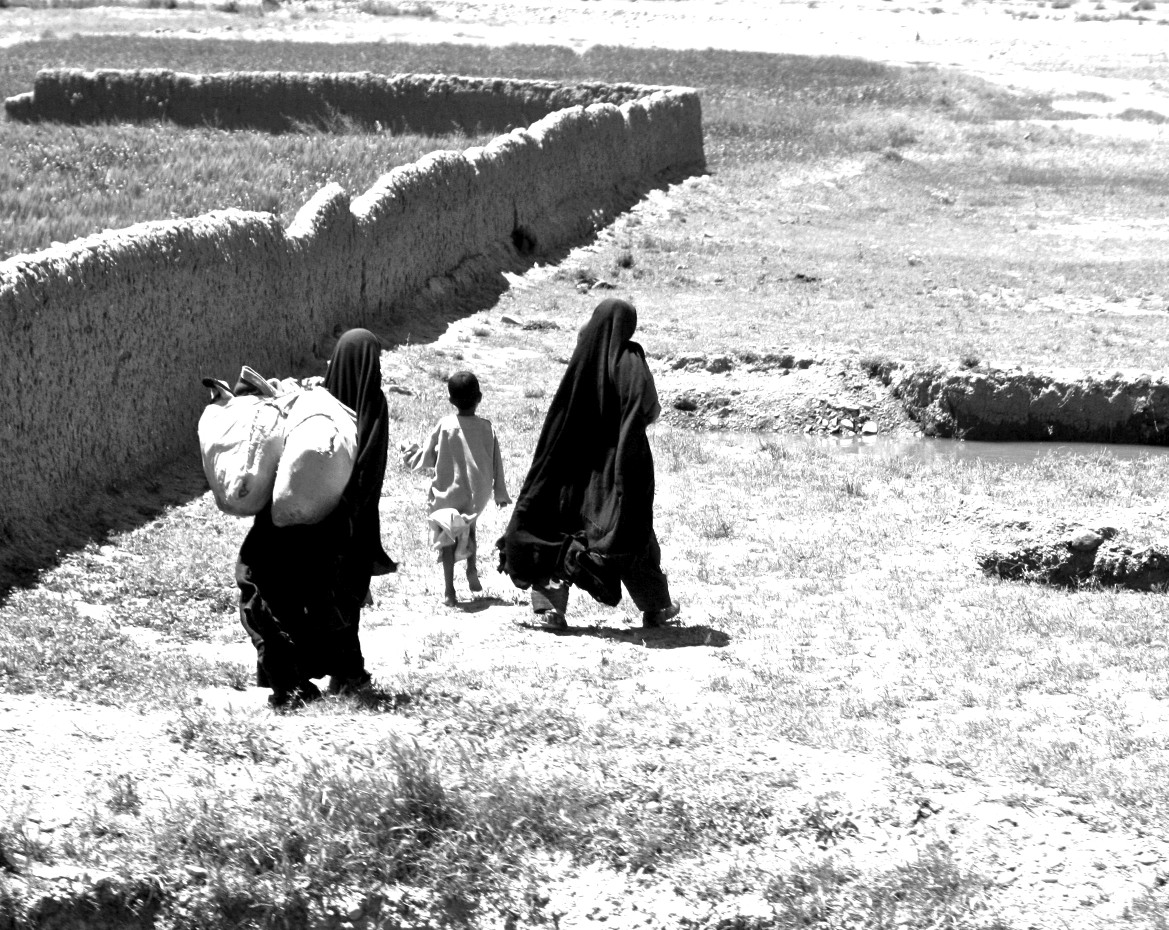
Nomad women returning to their village, south of Herat


South Kabul

Whats left of the wall around Kabul


Men outside the Masjit-Jami in Herat

Whats left of the famous minarets of Herat

Herati children

Russian jet of the Afghan Air Corp


Tuesday, June 5, 2012

Herat, Afghanistan


February 2005. Herat, Afghanistan

After ten hours on the road from Kandahar and I was reaching the limit of my “fun meter”. The road had been hard, bumpy, long, dusty and cold, and my body was definitely feeling it. I was sure we were near the end but could not see it. My driver kept saying ‘next, boss, next’. I just didn’t know exactly what that meant. Descending from a mountain pass I saw a big, green valley in front of me. The first structure I noticed was a gateway; a clean, white granite looking arch welcoming my convoy to my destination…the city of Herat, the crossroad of the Silk Route and cultural center of ancient dynasties and kingdoms; a city torn between culture and wars.

Herat was built before 500 B.C. and was probably known as Artacoana or Aria. Starting with a young man that became king in 336 B.C. at the age of twenty, it has been conquered, destroyed and rebuilt several times. Alexander the Great came through in 330 B.C. and made Herat one his great cities. Alexander built the fort that to this day still stands guard in the middle of the old part of the city.

On my first outing in Herat I told my translator and my driver to take me to see the city and tell me all they knew about its history, what a wonderful mistake that was. I quickly found out that Heratis are fiercely proud of their city. They proceeded to bombard me with names, years, and facts. My mind was like a sponge, trying to absorb everything. And since most Afghans are illiterate and haven’t gone to school, it meant that the information I was getting from them was probably obtained by word of mouth. As to the accuracy and veracity….well…needless to say, I checked everything they said, and to my astonishment I found most of it to be accurate.

The first place they took me was to the plains located to the west of the city. The year was 1222 and the Mongol king Genghis Khan had just returned to lay siege and destroy Herat. With him were close to 80,000 warriors. I was told the plains were full of warriors and great battles took place there. The citizens put up a great fight, but after a bloody siege that lasted 6 months, Genghis Khan and his Mongols ravaged the city, leaving behind only 40 Heratis alive, so the story goes. My guides spoke of these things with great enthusiasm, as if they had been there themselves.

With a population of around 800,000 people, Herat is a good size city. The influence of Iran, which is only an hour drive to the west, is very noticeable in the modern looking stores and all the wares you can buy, all imported from the western neighbor. Everything from satellite dishes, to computers, to Tupperware bowls can be found in Herat. New modern buildings are sprouting everywhere, all of them with a green glass façade that must be the latest trend somewhere. From a ceremony hall built by the former governor, Ismael Khan, to a modern apartment complex selling for $30,000 per unit, the green glass is everywhere. Modernism is much more pronounced here than in any other city I have been in Afghanistan.

From where the car was parked I looked to the north east and saw very tall towers that looked like factory smoke stacks looming well above the highest structure in the city and immediately asked my ‘tour guides’ if Herat had any factories. What I was looking at was the remnants of the once great “musalla”.

In 1381 Tamerlane completely destroyed Herat. But it was his son Shah Rukh who rebuilt it, along with his wife Gawhar Shad Begom, the daughter of a Turkish nobleman. Together they constructed universities and started a cultural renaissance in Herat. Gawhar Shad is credited with building, around 1405 A.D., the Meshad Mosque, a college and a mausoleum, together known as the musalla. Only 5 of the glorious minarets remain standing tall and proud, one of them leaning precariously to the east on the verge of toppling over. At the moment efforts are being made to prevent it from collapsing.

Still to this day, Heratis pride themselves in being well educated and cultured. According to them they are the most educated and literate people in the country. One can see this, for example, in the amount of bookstores that dot the city. It seems like you can’t pass a city block without seeing books advertised. And perhaps for this level of culture and knowledge, Herat has been sought after by many conquerors.

Around 1873 the Persians came once more and laid yet another bloody and ruthless siege on the city. The rulers of Herat at that time were advised by a young British major named Eldred Pottinger. Some have stated that if it had not been for Major Pottinger, Herat might have fallen into the hands of the invading Persians. This fact earned Pottinger the nickname of Hero of Herat.

Towards the beginning of the 1980’s, Heratis stood defiantly, once again, against the soviet invaders. To teach the inhabitants of the city a lesson and to capture the city, the Red Army sent 300 tanks to attack Herat. After the smoke cleared an estimated 5,000 citizens lost their lives and the Soviets had the city.

Under the leadership of the powerful Mujaihadeen Ismael Khan, Heratis survived not only soviet aggression but Taliban submission. Ismael Khan, the self-named Emir of Herat, cleaned up the city and maintained order, although sometimes too strictly, prompting locals to admit that there was little difference between Ismael Khan’s authority and the Taliban regime. In 2002, in a faint attempt to promote himself as a forward thinking leader, Ismael Khan declared that women did not have to wear the omni present burka; however, it is always up to the woman’s male relatives as to what she can or can’t do, what she can and can’t wear. So today the women of Herat continue, for the most part, to wear the burka.

And now, in the first decade of the 21st century, Herat stands to become the most modern city in the country and once again the cultural center of Afghanistan, moving far ahead of other Afghan cities.

Saturday, June 2, 2012

The Mujahadeen Commander


Written in Herat City, Afghanistan
May 2005


His gaze was intense, his clear blue eyes burning with an intense fire fueled by years of fighting. His hands were strong and rough like sand paper, no doubt from thousands of firefights, shooting his trusty AK-47 assault rifle. As we sat on big cushions in a small, dark, smoky room in the back of one of his restaurants, we drank green tea and ate bread, he spoke to me of hard living; living in the mountains with nothing but the bare necessities; of coming down to Herat under the cloak of darkness and in disguise; of not trusting anyone but his close circle for fear of betrayal to the enemy; of losing over 600 soldiers, 96 in his own personal staff. He spoke of being close to getting captured on several occasions, and barely escaping certain death…by decapitation. But even while speaking of this, he said it with a smile on his face, for he knew that he and his band of fighters outlasted and defeated the “Bear” and the “Students”.

As he described events in the not too distant past, the look in his face betrayed the glory of having won battle after battle, of having won the war, or in his case…the wars. The Commander talked easily and freely about skirmishes with the Soviets, about setting ambushes 50 meters from them, about spending time after time not letting them get more than 50 meters away. When I asked him why so close, he responded that during that time the Soviets had airplanes and helicopters in the sky constantly, like fire-flies, everywhere, day and night. They had to stay that close because they knew that the Soviets wouldn’t bomb themselves, so, ironically, there was safety being extremely close to the enemy.

The commander and his group fought every day for 20 odd years….everyday. Every minute was a struggle to survive, to stay ahead of the enemy, to stay alive. Every dawn brought a new set of problems; a new challenge to overcome. Sometimes they would run out of ammunition, sometimes the ammunition was bad, sometimes the weapons were faulty. Other days it was plain and simple…there was no food to eat. And still they forged ahead, led by this indomitable, fearless, formidable mujahideen. And they fought until the day the enemy was conquered…and then what?

I asked the commander what happened to him and his mujahideen after the Soviets left, after the fall of the Taliban, after there was no more enemy. He said that along with his soldiers he stayed under the command of his old commanding officer, Ismael Khan, who once again became governor of Herat. Khan rewarded his trusted field commander by making him head of his own security. Needless to say, he is still “someone” in the city.

And now, after almost four years since the defeat of the Taliban and with his boss and comrade in arms gone to the new Afghan government in Kabul, this old jihad fighter is building and dedicating a museum to his fallen comrades. He is building The Mujahideen Museum in Herat. There are tanks, helicopters, artillery pieces and landmines amongst many other things to be displayed when it opens. The best part is that these are not replicas or training items, but the real thing. One can still see the scorch marks in the ordnance and the bullet holes in the helicopters.

When I visited the site on February 2005, there was a fresh blanket of snow on the ground and it was cold, very cold. The snow covered everything, as if concealing it and keeping it ready for action; however, the commander, now a general, told me the reason for this museum is that he wants future generations of Afghanis to remember what they all went through, the sacrifices his comrades made. He wants them never to forget how they persisted against all odds and beat the mighty Red Army. He wants to do this by showing his Afghan brothers the “tools of the trade”, the tools of destruction.

One great example is the Soviet Mi-24 HIND helicopter gunship sitting in the front of the museum. The HIND was one of the most feared Soviet military machines. It caused fear with the destruction it projected. Even my translator, upon seen it kicked it a few times. When I asked him why he did that, he simply responded “because it killed many Afghans, I hate it”. No one was safe nor could escape the Hind’s lethal power. In the end, the Mujahideen downed over 300 HINDS with shoulder fired, surface to air missiles.


I was told the museum items have been inerted and demilitarized for safe display. The last thing the General said to me was there will always be another fight that needs winning. I am sure that should Afghanistan be invaded or involved in another war, the General would take his place amongst the great leaders and take up arms once again and defeat whomever needs defeating…along with his ‘museum’.